Autonomous UAVs
Client
Confidential
Industry
Defense
Demanding environments require smarter machines. At Outrigo, we develop autonomous UAVs designed to operate in demanding real-world environments.
Understanding the Challenge
Operating UAVs in unstructured, GNSS-denied, and contested environments presents a multi-variable autonomy challenge. Conventional flight controllers and rule-based planners degrade rapidly when exposed to stochastic disturbances such as wind gusts, dynamic obstacles, or unmodeled environmental changes. The critical limitation lies in decision-making latency and adaptability, particularly when real-time responses are required under incomplete or degraded sensor information.
Solution
Outrigo addresses these challenges through a tightly integrated, end-to-end autonomy ecosystem:
Integrated Hardware–AI Co-Design: Mechanical architectures are developed through CAD-driven optimization and realized via additive manufacturing and advanced composite materials, enabling rapid iteration, high thrust-to-weight ratios, and structural robustness.
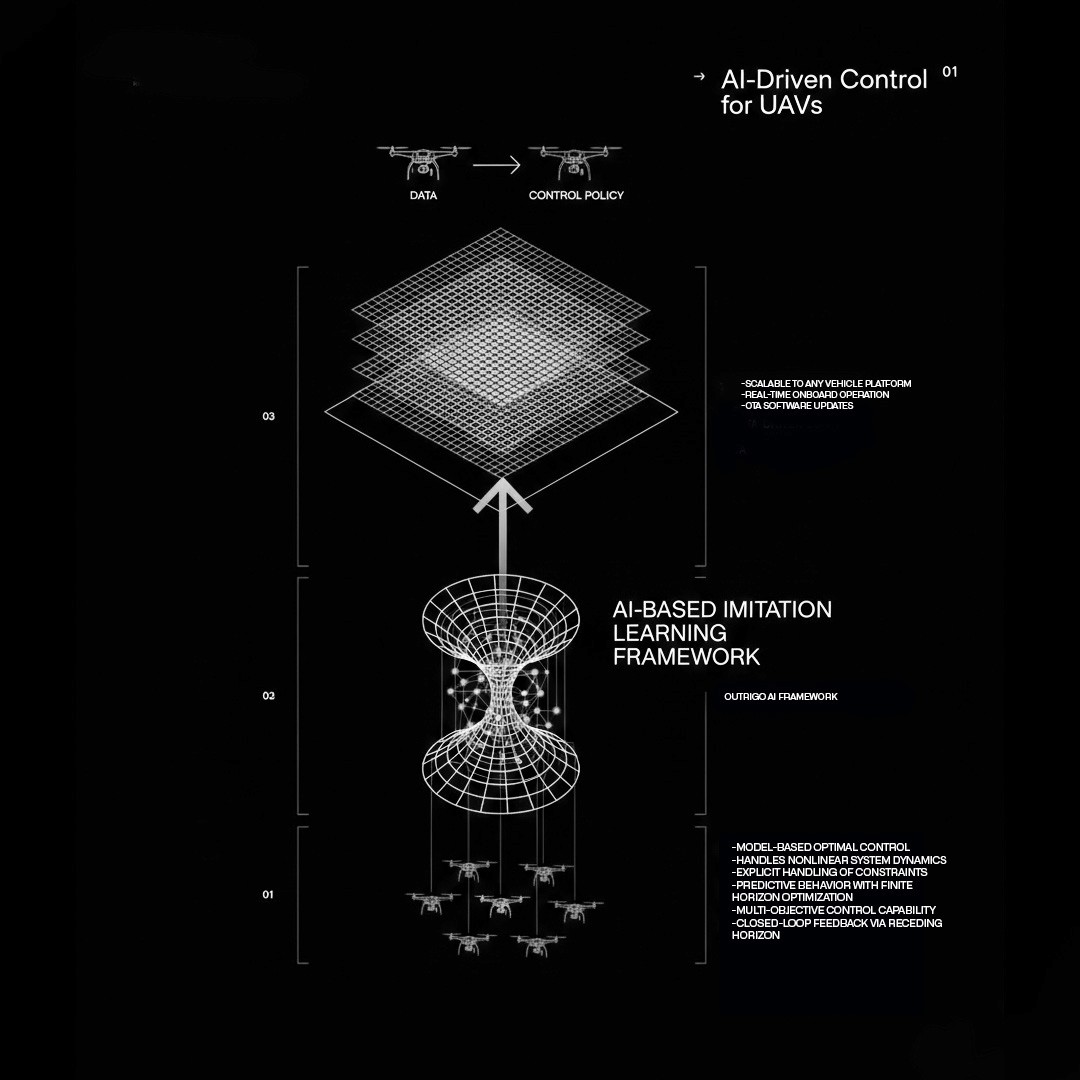
Hybrid Model-Based and AI-Driven Control: Autonomous flight control combines advanced model-based methods with AI-driven adaptive policies executed entirely on-board. Neural network inference is deployed at the edge, enabling low-latency control loops capable of responding to previously unseen environmental conditions in real time.
Closed-Loop Validation Pipeline: A continuous validation workflow links high-fidelity physics-based simulation (digital twins) with experimental flight testing, ensuring robust generalization of learned models and safe transfer from simulation to real-world deployment.
Results and Applications
The resulting platform demonstrates:
• Sub-second adaptive responses in highly dynamic and unknown environments, significantly reducing collision risk.
• Full operational autonomy in industrial inspection and infrastructure monitoring scenarios where remote piloting is impractical or impossible.
• Deployment readiness for mission-critical applications—including emergency response, logistics, and defense-related operations—requiring resilient autonomy, degraded-signal tolerance, and validated real-flight performance metrics.